About Social Issues
May 14, 2014
Working With Sharks: A Pakistani Activist’s Successful Battle Against Sexual Harassment
Working with Sharks, a compelling account of a leading Pakistani gender activist, Dr. Fouzia Saeed, against sexual harassment at the workplace, was released in the United States on March 8 on the occasion of the International Women’s Day. When a slightly different version of the book was published in Pakistan in 2012, it opened up a serious nationwide public debate about sexual harassment against women at workstations.
Prior to the publication of the book, Dr. Saeed drafted two bills against sexual harassment in 2008, which got into the legislative process and — through her intensive lobbying — the Parliament in Pakistan unanimously passed both the laws making sexual harassment a crime and mandating every formal sector to institute an anti-sexual harassment policy. The prime minister of Pakistan declared December 22, the day this case was filed, the national day of working women. The new laws invariably gave the Pakistani women a sense of legal protection.
While issues of female education, honor killing and acid attacks on women have recently found some space in the mainstream national debate in Pakistan and international attention, sexual harassment, on the other hand, still stigmatizes the victims. Very few courageous women, such as Dr. Saeed herself, have appeared in public to fight against this practice. Her book has inspired and encouraged young working women in Pakistan to break their silence against sexual assaults from their bosses and staffers. Very few books change an entire pattern of collective behavior and Working with Sharks is indeed one such book in Pakistan that has reshaped a society’s behavior and response toward issues that people seldom talk about in the public domain because of the fear of being scandalized or otherwise blamed for inviting trouble.
Dr. Saeed, who is currently a visiting fellow at the National Endowment for Democracy (N.E.D.) in Washington D.C., has worked for more than three decades for women’s rights in her native Pakistan. In 2001, Dr. Saeed stunned the Pakistani society with her revealing book Taboo: The Hidden Culture of a Red Light Area, the first research-based account of Pakistani female sex workers and their secretive troubled world. Taboo initially was received with discomfort by the social conservatives in Pakistan but it ultimately encouraged the society to have a frank discussion about the rights of those who have been pushed into the sex industry and face social and economic discrimination.
Working with Sharks is a firsthand story of the author and how she experienced sexual harassment at the prestigious place of the United Nations Development Program (U.N.D.P.) in Pakistan. The story brings to light not just the courage the author exhibited by standing up against a senior manager’s behavior, but also the torture she went through to counter harassment and cover ups by the international senior management in the organization’s Pakistan office for almost two years.
When Dr. Saeed, the author, bravely stood up against the intimidating behavior of her manager, 10 other women also showed courage and came forward to speak up against similar harassment they had also faced in the organization. These women’s struggle turned more difficult after the United Nations, according to the author, came down to protect the manager accused of sexual harassment against the female workers who had lodged complaints against his objectionable behavior. In the face of all odds, these women persisted and pushed their case to a higher level where ultimately a senior bench was designated with senior U.N. officials from organizations outside the U.N.D.P. to provide justice to the fighting women.
In Pakistan, before the launch of this book, the author organized a silent auction for the first 10 copies of the initial edition. People from different countries bid on her book. The highest bid for the first copy, Rs 125,000, was offered from a group of women working in the U.N. to show support with the author and other women who stood against sexual harassment. Those who won the Rs 125,000 bid asked the author to send their copy to the secretary general of the United Nations.
The author regrets that the U.N. secretary general never acknowledged receiving the book which focuses on such a negative practice inside the U.N. system and elsewhere.
Working with Sharks is a depressing reminder of the fact that sexual harassment does not only take place in developing societies or among less educated, trained staff members. This is a universal challenge that simultaneously requires Dr. Saeed’s courage to agitate against and strict laws that protect women in the workplace.
The U.S. edition of Working with Sharks is not a typical story of gender discrimination against one woman in a conservative third world country. It is indeed a different book that talks about courageous women’s continued struggle, unflinching determination and ultimate success in hard countries like Pakistan. The book illustrates how women take their battles in adverse circumstances and still succeed through organized efforts. Most recent books on Pakistan have focused on depressing topics like terrorism and extremism in the nuclear-armed Muslim nation but Working with Sharks portrays a different Pakistan where women have sustained their rights movement and also written some remarkable success stories.
December 26, 2011
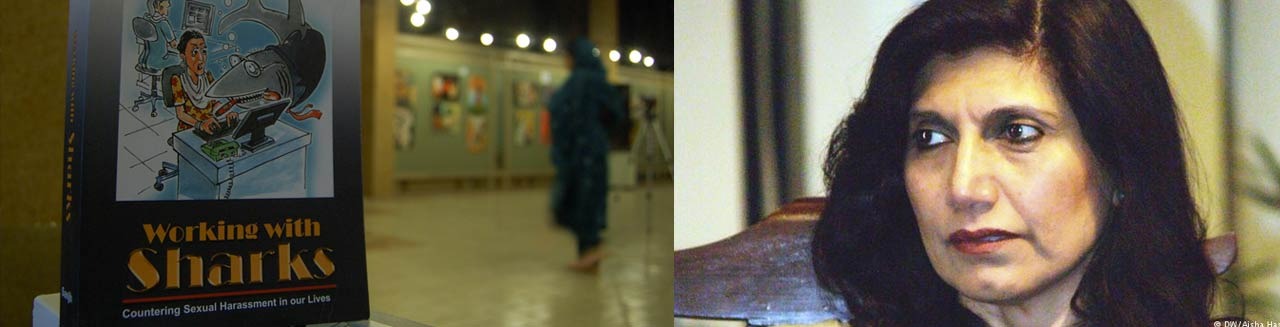
Working with Sharks by Fouzia Saeed
Introduction:
“Little did I know that my intimidation by senior officers in the UNDP had only just begun.”
Fouzia Saeed dreamed of bringing social change to the women of Pakistan and was thrilled to land her dream job at the world’s ethical compass and institutional tour de force: The United Nations.
As expected, the UN was a gathering place for passionate minds devoted to human rights and justice for all.
Shockingly, at the UN mission in Pakistan it was also a breeding ground for powerful men who viewed women as sexual objects rather than professional equals.
Refusing her boss’s advances didn’t stop the harassment. Reporting him to superiors didn’t either. In her years-long struggle with torment and humiliation at the UN, Fouzia held strong, knowing her fight for women’s rights was the only thing that could keep her going.
But how do you fight for others’ rights when you cannot even take hold of your own?
Can you ever change a culture that views sexual harassment by a man as a woman’s crime?
Fouzia and a group of female colleagues, who similarly suffered in the workplace, gained the courage to risk their reputations. They filed a joint complaint and promptly found themselves under attack by their managers who aligned with the perpetrator in an effort to crush their case.
Working with Sharks follows eleven indestructible women and the case that sparked a national movement and culminated in the passage of legislation that made sexual harassment a crime in Pakistan in 2010.
Inspirational and poignant, Working with Sharks encourages women in any part of the world to find their voice and stand up to sexual harassment.
December 22, 2011
Working women sexual harassment projected by AASHA!
On Thursday, January 31; An assembly by Alliance Against Sexual Harassment (AASHA), which comprises of organizations including: Actionaid, Mehergarh, Bedari, Pilor and Intereko Resource Center, was held in Best Western Islamabad at 11 am and ended at 6 pm.
In the conference many working women flee from all corners of the country including cities like Karachi, Lahore, Faisalabad, Chakwal and many others. The women attended the conference are working in different factories including nurses from different hospitals.
The conference was headed by Dr. Fouzia saeed from Mehergarh and Aqsa Khan from Actionaid. The chief guests were Madam Mehnaz Rafi and Doniya Aziz, member PML (Q), Saeeda Arfa Zahra from NCSW and Saima Khar from PPP and renowned Poetess Kishwar Naheed were present.
The conference started with a stage play in which the problems and how a young nurse being harassed by the male doctors and nurses. It also depicted the mental trauma through which women suffers as she has no one on her back who would listen to her and help her instead she will be the one to be blamed and fired from her job.
The debate was that why working women of Pakistan are being harassed and what consequences they have to face. On the AASHA platform the NGOs representatives presented a code of conduct for gender justice and demanded for the protection of working women in Pakistan. At this point Saeeda Arfa Zahra said and I cote “Men kill women for their own honor, if it is about their honor why do not they kill themselves. If it would be about our honor we will kill ourselves by ourselves”, on this women in the hall clapped with all their hearts. She also added that women have to make their own identity and stand strong. They are neither helpless nor weak only if they know what their strengths are.
The code of conduct for gender justice had 15 points; some of them are as follows:
It demanded that women should not only be referred as mothers, wives and daughters but they should be taken as a human being first, as they are much more than their relations with the men in their lives.
It demands that women should be provided with social and legal protection at work places.
Asked from political parties to clearly state what they will do for the working women in their mandate.
To have legislation that gives women protection against sexual harassment at work place.
Government should institutionalize the code of conduct for gender justice (anti sexual harassment policy) for all the government hospitals and health services.
The government of Pakistan honors the international commitment i.e. CFDAW, ILO Convention 100 and 111 that covers fundamental rights of men and women at work
Later that evening after lunch break the visiting working women were divided into three groups:
General problems
Factory workers
Nurses
Within these groups, women shared their experiences of harassment at their work place and tell how society and locality members treat them if they know about their harassment. One of the factory members said that it does not matter who’s fault is it, woman is the only entity being blamed for every action and situation. People point fingers on her character no matter how poise she is. Women also complained that managers and owners prefer young beautiful women for their organization and give them better salaries as compared to the older women who are degraded and appointed at less salary.(we in the cities relate to it by knowing the fact that young beautiful girls are prefered for reception jobs)
While talking to Dr. Fouzia Saeed few students of different universities complained that their male teachers use degrading and abusive words for women while teaching women. And prefer giving good marks to those who have good looks. In answer to that I, as was also present there, said that being a student I think ones most important concern would be to get good grades and if that person knows that teacher will give her that, if she smile to him, she would do that because she has to survive in her college or university and in her practical life as well. So blaming a woman for being beautiful isn’t right. another problem is that in women universities such as Fatimah Jinnah Women university, Rawalpindi smoking is prohibited to keep the environmnet clean but the outsiders, male, and faculity memebers are allowed to smoke. the point is if they are then why not university students? in our society smoking is related to one’s character specially if its a woman who smokes but for men there is always an excuse or explanation.
There were many core problems being discussed which I think it would be better if we talk on those on this platform with my readers through discussion.
Is there any solution to stop women discrimination and harassment? Can we give a better life to the women of Pakistan? Will men ever stop taking woman as an ornament? And treat her as a fellow human being but not as someone’s daughter, mother or wife?
Is there any change in the behavior of young men and women of today’s Pakistan or they are as well following the foot steps of deep routed behaviors of men, from centuries, towards women?
At the end I salute those women who came to this conference and shared their experiences without any hesitation or shyness. I think you and I can never have this much courage to tell more than 100 audience that you have been abused or harassed. Hats off to them.
Give it a deep thought and then write what you think of it.