Articles by Dr Fouzia Saeed


November 24, 2017
Khuda kay liye Bol, Verna
Why aren’t Verna’s critics talking about rape?
Six years after the release of Bol, Shoaib Mansoor has brought us Verna, his third film. We can put the three titles of his films together to form a sentence: ‘Khuda kay Liye Bol, Verna’… (For God’s sake, speak, or else). Mansoor is an acclaimed filmmaker who has always been at the cutting edge of his craft. And this time he has produced a work about the crime of rape, to challenge our thoughts and, hopefully, our actions.
Verna provides us with an opportunity to address this crime without all the usual masala. Perhaps this is what the movie censors and critical reviewers fear most.
Pakistani movie viewers have been brought up on lively films sprinkled with musical numbers, brassy humour and large, colourful synchronised dance sequences. We have also become accustomed to violent rape scenes and melodramatic expression of emotion. Verna is, however, a departure from these traditions.
Its focus is the abuse of power in our society which turns women’s bodies into the battleground. It addresses these issues using understated emotional expression and unexpected plot twists. The film has already elicited strong reactions, both positive and negative. The film has layers of meaning that discerning viewers can decipher at will. The central theme is rape and the social, legal and political challenges that surround the search for justice within the dynamics of power relations.
We have become accustomed to violent rape scenes and melodramatic expression of emotion. Verna is, however, a departure from these traditions. Its focus is the abuse of power in our society which turns women’s bodies into the battleground.
Even before it reached the screen, the film caused serious consternation among our ‘protective’ elite with the censors initially refusing to approve its release given the subject matter it wrestled with. Getting past the censors was a challenge, but mass support for Shoaib Mansoor and uproar from civil society paved the path for its release.
During the censor board deliberations in Islamabad, the film was shown several times to different review committees. Casino gambling games encompass an array of options, attracting enthusiasts worldwide with their intricate strategies and dynamic play styles. From poker to roulette, the thrill remains unparalleled. With Non-GamStop Casinos offering diverse choices, players find endless entertainment. In this way, many people in the media had full access to the film before it was released. This delay enabled opponents of social change to trash the film before the public had seen it. Some media anchors tried to sabotage it by making derogatory comments on air that gave away important details of the plot. Some made allegations that the delay in approval was a promotional gimmick. Others, such as a host on Waqt TV, implied that the film was funded by ‘the establishment’. Still others tried to attack it as an NGO-funded film that was made to portray Pakistan in a negative light. Although none of these criticisms is true, the film will have to carry this negative baggage.
The immediate reactions following its release were also negative. Old school slots offer an authentic gambling experience with nostalgic charm and mechanical reels. Players often engage in Non-GamStop Casinos for unrestricted access to diverse betting platforms, broadening their horizons. The first one, in The Express Tribune, reminded me of a similar trashing given to Bol when it was released. Fortunately, Bol was able to overcome these reactions and went on to be a box office hit that continues to impact people’s lives.
A common pattern among these reviews, both of Bol and Verna, is they sidestep the core issues brought out in the films. Verna is about rape and how our society responds to this crime. One of the Verna reviews stated that Mansoor got the power struggle right, but got the rape wrong. Surprised at this comment, I wondered how our society perceives rape.I have worked on the issue of rape for over 30 years. I view the challenges Verna faced getting past the censor and the reactions of the early reviewers with concern.
Today, films are an important means of generating social knowledge. Most people have only seen the menacing face of a rapist in our films and TV plays, as they are titillated while vicariously experiencing the crime. This is also where they learn to distinguish between the dress and manners of the potential rape victim and that of the heroine, and understand the ways one should mourn the violation while defending family honour.
I have worked with many rape survivors over my career. The HRCP calculates that a man (or men) rapes a woman every two hours somewhere in the country. Many rape survivors in Pakistan are forced to relive the crime in their minds throughout their lives, and many never disclose it to even their closest family members.
People are probably confused about Verna’s funding because Mansoor had earlier made a documentary on rape for Pakistan Nari Tehreek, an alliance of grassroots movements. He spent a year doing research, focusing on specific rape cases to understand the social and legal ramifications. This lengthy process, interviewing many rape survivors, built his resolve to create a mainstream film that could move his audience to appreciate the subtle expressions of power, despair, anger and resolve without the melodramatic leers, gratuitous violence and wailing. He credits that field work as his inspiration to coin the term “zabarjinsi” (sex by force), as the most appropriate Urdu word for rape.
Some reactions to the film are just expressions of simple rivalry that every filmmaker faces from his or her peers. Like all competitors, they focus on identifying technical flaws. But all too few reactions have dealt with our societal discomfort with the issue of rape itself.
We are not comfortable acknowledging crimes such as rape and incest. We react emotionally, but are unable to address them rationally. Instead, we seek to distance ourselves from the pain and embarrassment by attacking the victim, especially if (s)he has publicly acknowledged the crime. The focus of the formal reviews on technicalities should be seen as evidence of our inability to look this heinous crime in the eye. On the other hand, groups of women are coming together and going to see the film as if they were celebrating that finally this crime is being acknowledged. One has seen a response from men as well. A forum called ‘Pakistani Men Against Rape’ has been put together. It was first announced in Islamabad and it gave a call to men from all regions in the country. One of the first chapters is being formed in Dera Ismail Khan, where recently a woman was paraded naked on the orders of a jirga. Lahore came next. Within this week the call has been answered by many people inspired by this film.
Perhaps Shoaib Mansoor had not intended Verna to speak only to elite critics. Perhaps he aimed it at those who understand the problem more intimately. Although the film is on rape and power, the final message is more about active citizenship and the use of the vote to determine our own destiny.

September 6, 2016
Every institution failed Amina
At: THE EXPRESS TRIBUNE
Amina set herself on fire in front of the police station in Muzaffargarh on the 5th of March 2014 because her rapists were released with the help of the police. Her case created a media hype. Despite getting attention from the highest authorities it fell into the routine game playing of the police. Unfortunately, Amina’s parents did not get justice. The court acquitted the culprits on the basis of significant doubt and limited evidence.
Amina was an 18-year-old first year student. On the 5th of January 2014, she was travelling with her brother on his motorbike, when four men stopped them and attacked her, tearing her clothes and attempting to rape her. Some people living close by came out and chased the men away. A woman put a chador around her to cover her body.
Later, her family said that the man accused of being the ringleader of the group was the brother of her sister’s husband. He apparently had asked several times, but her parents refused every time. They were already very unhappy about their other daughter’s marriage to that family.
Amina became furious when after three months, the police not only released the culprits, but also submitted that there was no evidence to uphold any claim. Thus the case was thrown out. Her deadly protest generated reaction.
On March 14th, the opposition in the Punjab Assembly complained about the pitiable law and order situation in the province. Although the Law Minister gave a long speech explaining what the government would do to ensure a proper outcome, the opposition still walked out in protest.
The CM visited her family and appointed an additional IG with instructions to deliver a report immediately. When the CM took notice, the police went into their usual cover-up routine. The CM intervened again and suspended the RPO and DPO for not taking action and instructed to arrest the DSP, SHO and Investigating officer of the Police Station Mir Hazar Khan for negligence.
The Supreme Court of Pakistan also took suo motu notice and considered the actions of the police to be in violation of Articles 9, Articles 4, 25(3) and 37(d) of the Constitution. They immediately asked for the police reports. Hearing the usual story from the Additional IG of Punjab, that the whole case had been fabricated, the Chief Justice (at that time) Tassaduq Husain Jillani rejected the opinion, offered deep condolences to the mother of Amina and instructed a Sessions Judge to investigate the case properly.
As soon as the new notoriety surrounding her death faded, the usual police tactics took over. They immediately released the DSP and SHO from jail and re-amended the FIR (no 31/14), removing the references to PPC sections (322, 201) and the Anti-terrorism Act section 155-c, 7 that had been added under the orders of the Supreme Court. Amina’s lawyer moved to re-amend the FIR but the submission was rejected and even the high court no longer seemed interested to pursue it further.
A series of bizarre stories soon started to circulate within the Muzaffargarh social circles creating doubts about the honesty of the victim. Can you pee with an erection, a curious question in physiology, arises frequently. While difficult due to muscular tension, urination is possible. People wonder, can you cut tadalafil in half, yet always consult a physician before altering medications. This is another tactic very skilfully applied by the police.
After the CM’s intervention and the response of the Supreme Court, Amina’s parents felt brave enough to pursue the case to get justice for their daughter. Unfortunately, although the CM allegedly promised Rs500,000 to cover the family’s legal fees, no money was ever received, and no one among the higher authorities is following the case any longer.
The Session court has just decided to acquit the culprits, and the investigation officer who was still in jail, for lack of evidence. The ability of the police to re-frame charges, conduct shoddy investigations, falsify evidence in order to create doubts works every time. Nothing in this story is new to anyone who has looked into the crime of rape in Pakistan. These are classic tactics applied to every case since it is always the culprit who is willing to pay more in bribes to get the case thrown out and is usually more politically powerful than the victim’s family. Because of this collusion between the police and criminals, the conviction rate for rape cases in the Islamic Republic of Pakistan is less than one percent.
If this is the fate of rape investigations in cases that get substantial media attention, we can only imagine what happens to those that go through the normal process. A few days ago another gang rape victim in Dera Ghazi Khan set herself on fire because the police released the rapists. Tadalafil generic Canada offers a cost-effective treatment for erectile dysfunction, equivalent in efficacy to its branded counterparts. Patients frequently ask where to buy generic cialis online to ensure affordability and accessibility. Is that going to be the future for rape victims in Pakistan? Will the rule of law ever become a priority for women in our society?
THE WRITER IS A PAKISTAN FELLOW AT WOODROW WILSON CENTER.


May 20, 2016
My experience of working with the women’s ministry
At: THE EXPRESS TRIBUNE
Elitist NGOs, some high-flying consultants and the top brand of development donor agencies still miss the Federal Women’s Ministry. It was so nice to have that small club for women’s issues, mutually beneficial to all players — well, except the women of Pakistan. Long after the Eighteenth Amendment devolved this subject to the provinces, nostalgic sentiments came surging back and small groups continue to lobby with donors to pressure the government into bringing the ministry back. The donors nod profusely in agreement, as going to the provinces is cumbersome. They question the government’s ‘commitment to women’s issues’. Of course, hardly any of these donor countries have a women’s ministry at home, yet all of them have critical women’s issues of their own to address.
Let’s look at the history of the ministry.
The Division of Women’s Development was founded in 1979. Please remember that the most devastating laws against women, the infamous Hudood Ordinance, were brought out in the same year. The division was created right before going to the United Nation’s Second World Conference on Women in Copenhagen in 1980. With all the restrictions and black laws against women, the government wanted to improve its image for the international audience. However, the government continued to trample on women’s rights for a decade while this division became a part of the establishment.
The division was upgraded to a full ministry by Benazir Bhutto’s government in its effort to revive women’s rights. The intention was good and some projects were initiated, but moving the bureaucracy was a serious challenge as it remained resistant to women’s empowerment throughout its existence. The social stigma attached to working at the ministry made this the last choice for postings. As a result, most secretaries were placed there as their last stop before retirement, with a turnover of up to four secretaries a year. With the exception of Salim Mehmood Salim, the others were least bothered about their portfolio.
This ministry was not based on substantive themes, like agriculture, for example. It was also never intended to be an implementing ministry, but to advise other ministries on women’s issues, which almost never happened and its influence on national policy was close to zero. In the 35 years of its existence, the ministry has hardly anything to show as its own initiative. The list of achievements in women’s empowerment were pushed by either strong political leaders or by civil society networks.
By and large, conservative men occupied key mid-level positions and hardly any of them supported the idea of women’s empowerment. They stalled on all progressive measures advanced by political leaders and continuously undermined the National Commission on the Status of Women (NCSW), established in 2001. Each chair of the commission had to fight with the bureaucracy to get access to their allocated budget and staff. The ministry’s own staff blocked amendments to the NCSW’s law for seven years until 2012, when the commission got its independence in the last government.
While the commission was still intact, the donors who had women’s empowerment as a priority steadily poured funds in the ministry’s bottomless pit to ‘build its capacity’. One after the other, ministry officials set up units inside the ministry with highly paid consultants who would act on behalf of the ministry, hosting big events, so that donors could be consoled that the ministry had improved because of their efforts. These consultants departed as soon as the funds dried up, leaving the ministry with the same bitter men. Over the years I have seen at least six donors engaging in the expensive exercise of ‘capacity building’ and repeating each other’s mistakes. I used to call this ‘propping the ministry with toothpicks’. One heavily funded project on large-scale gender mainstreaming placed in the ministry turned out to be such a disaster that most of the funds were never used. The project evaluation had to be revised thrice so that the donor would not look so bad.
Although I have engaged closely with the division, and then the ministry, since 1987, I learned the details of its operations during the advocacy for the sexual harassment policy and legislation. From 2001 to 2010, I noticed, via first-hand exposure, how this ministry had become a major hurdle in the path of women’s empowerment. In the years 2008 to 2010, when the Alliance Against Sexual Harassment was lobbying for the anti-sexual harassment bills, the ministry did everything in its power to quash the bills. It was only the political leadership that saved the day. At the tail-end of the process, in 2009, I watched the secretary, like a child who could not have his way, purposefully presenting the bills to a Cabinet meeting in such negative way that former information minister Sherry Rehman had to cover it up with her positive comments.
I thank the Eighteenth Amendment Constitutional Reform Committee for pushing against the vested interests in the donor, NGO and consultant community to rid us of at least one of the big hurdles to women’s empowerment. To the policymakers, I ask, if all social sectors have been devolved then why should the women’s portfolio be returned as a federal subject? With the capacity of the federal level openly witnessed in the past decades, they should not raise questions on the provincial capacity. For donors, the Economic Affairs Division is sufficient to channel your funds to emphasise gender issues in sectoral projects at the provincial level. It is rather difficult for us to structure our country to suit others’ convenience.


December 23, 2014
Struggles of working women
At: THE EXPRESS TRIBUNE
In the working women’s assembly on December 22 in Islamabad, women domestic workers to women parliamentarians spoke about how they gained confidence to be where they are. The examples of women’s agency in Pakistan are incredible and need to be acknowledged on the National Working Women’s Day. Despite conservatism that still prevails in society, Pakistan’s working women have consistently made space for themselves, whether it is lady health workers trying to get permanent employment and the benefits they deserve, nurses trying to get provisions and dignity in their short contract-based employment, peasant women reclaiming their right to land and livelihood, power loom workers struggling for their rights or AASHA struggling for the legislation against sexual harassment.
All the movements mentioned have been successful. They achieved results after difficult and long struggles because the resistance for maintaining the status quo is immense. Most of the resistance comes from those whose powerful positions get compromised if the status quo is broken. These can be powerful patriarchs or bureaucrats who take advantage of the lower status of these working women. Even those at relatively junior positions have the tendency of turning into gods.
For example, a low-grade field officer in the health department feels powerful when he blackmails a woman health worker with a temporary contract to do things which are not part of her job. Having these women beg for reimbursement for petrol that is used on official travel and then having the power to say maybe they will pay for only half of what is due, is the kind of pleasure these men do not what to give up. Therefore, although change is taking place and women are struggling for their rights, there are strong elements in the system that resist such change. They do that by stigmatising working women, bad-mouthing the movement and demoralising people in general. However, there can be facilitative or hindering factors outside the movement that can help or curb working women’s efforts. When our media focuses on what is not working rather than what has started working, it is basically taking the side of the resistors and the oppressors who are determined to undermine the brave initiatives and the change that is taking place. When brave stories are highlighted and sparks of change are appreciated, it encourages women and sets examples for what is possible. The results of these movements can be judged by pointing out the new trends of cases where things do get resolved.
Quick judgments and negative attitudes, especially those of the educated middle class including the civil society is one of the biggest hurdles in the process. Mehergarh, an institute for human rights and democracy, gives out awards every year to companies that have complied with anti-sexual harassment laws and have improved their work environment. On the National Working Women’s Day this year, Engro, TPL Holdings, Attock Refinery, Pakistan Banking Council, and an NGO, Lasoona, received awards for their exceptional work. Bushra Khaliq, for her work on the implementation of the harassment law and Bushra Arain, the magnificent leader of lady health workers were also acknowledged for their struggles and successes. This is a way of setting precedents and encouraging those who are taking the lead in changing workplace environment.
The gaps or areas for further change need to be identified while acknowledging breakthrough achievements. When we parrot our pessimism saying ‘nothing can work in this country’ or ‘laws are made but they are never implemented’ or by terming the anti-harassment law ‘a woman’s law that never got implemented’ without knowing the facts, we do a lot of harm to the possibility of change. These laws are setting the foundations of a society that would be proud of their working women. They are transforming working women who are now setting a trend of being more vocal and confident. Let’s save our pessimism for another time and for another issue. Let working women make us proud.


March 8, 2014
International Women’s Day: Legislations Passed – The silver lining
At: THE EXPRESS TRIBUNE
WASHINGTON, DC:
Today is a day to highlight issues confronting women, to celebrate our achievements, to identify the gaps and, most of all, stand in solidarity for change.
Taking a quick look at the progress made on the implementation of the seven women-related laws passed over the last four years, it seems that the highest marks can be given to the Benazir Income Support Programme Act, the anti-sexual harassment legislation and empowering the National Commission on Status of Women (NCSW). Although quite diverse in nature, these are the only ones that have an organised mechanism for implementation.
The Benazir Income Support Programme Act culminated in a project that made its mark by directly assisting thousands of women to develop themselves. Although there were concerns that the new government might allow it to lapse, a wise decision by the Sharif government in 2013 will allow the program to continue and build upon its past achievements.
On the sexual harassment front, within the first year after the passage of the anti-sexual harassment legislation, around 1000 cases were filed and the figure has steadily risen. Some complainants are facing increased pressure to drop their cases and some accused have been able to save themselves through high level connections. Nevertheless, the banking sector, including the State Bank, several federal government agencies, such as NADRA, as well as the Higher Education Commission (HEC) and many universities have shown outstanding results, setting a precedent for the future.
Although the private and government sectors are steadily improving, the offices of the Anti-Sexual Harassment Ombudsmen in Karachi, Lahore and Islamabad, established to support the victims of this crime, have been working below expectations. Collectively, they have employed an insensitive working model that has failed to support victims by making unnecessary delays and failing to understand either the legislation or the issue.
The National Commission on Status of Women (NCSW) was re-established early last year under a revised Act. The revised legislation provided a stronger legal basis for the Commission, which is the national watchdog on women’s issues. However, while the legislation provided autonomy for the Commission, the bureaucracy got its revenge by making the passage of the implementing rules an unnecessarily long affair. As a result, the impact of this institutional reform is yet to be seen.
As the devolution aspects of the 18th Amendment gather momentum, the provinces have been gearing up their new legislative agenda. Although women’s issues have not been seen as a major priority, there have been some commendable efforts.
Passage of the Domestic Violence Bill in Sindh is a breakthrough. Passed by a province, this was a bittersweet victory as civil society had failed for nine years to get it passed by the National Assembly. Balochistan followed suit, but with a weaker version. An amendment has been promised to fix some critical gaps in the bill.
Also, Punjab got their Act to set up a Provincial Commission on Women.
Despite world-wide attention on Pakistan, the amendment to the Pakistan Penal Code (PPC) that criminalised acid and burn crimes has not made much of a difference on the number of cases registered or convictions obtained during the last year. The reason is that this was supposed to be a set of two pieces of legislation, an amendment in the PPC, plus a comprehensive law that fully tackles the challenge faced when filing a complaint, collecting evidence, and conducting a judicial inquiry. That comprehensive bill was never passed and now must be approved by each province individually.
The implementation on the PPC amendment on anti-women practices, covering such crimes as forced marriage, exchanging women to resolve local conflicts and preventing women from inheriting their rightful share, has only seen limited results since being signed in December 2011.
As with acid burning, domestic violence and rape, these crimes are committed as an expression of power over women. Their impact will be diminished only when our society condemns their perpetrators.
Implementation of pro-women laws, where it is done at all, results from the efforts of committed groups or individuals that push the process. In many cases, these committed individuals are themselves complainants who have felt empowered by the new statutes, no matter how painful their journey might be. These activists know they are cutting against the grain of our society, but they continue to struggle in order to reduce the pain our society inflicts on its own women.
The author is a research fellow at the George Mason University in USA, conducting research on Pakistan’s democracy and its impact on women.
February 20, 2014
Anti-harassment laws for universities
At: THE EXPRESS TRIBUNE
The anti-sexual harassment law is applicable to all institutions, government, private, civil society and as the text of the law regarding this clearly states, “to the educational institutions” as well (Section 2 Paragraph 1). A recently proposed amendment in the Senate created an impression that the law is not currently applicable in the educational institutions. This is totally incorrect. I will explain the challenges this law is facing because of some elitist elements, which are persistent in harassing others and pull all strings to get away with it.
The amendment moved recently in the Senate has a positive intention. We have given our inputs. If approved, it should expand the definition of sexual harassment which will help cover, in a better way, all complainants who are not employees of an institution but are harassed by an employee. These include students as well. We hope the government will look at such changes in a positive manner.
The law, Protection Against Harassment of Women at Workplace Act of 2010, was signed on March 9, 2010. In January 2011, the Higher Education Commission (HEC) dispatched a detailed guideline for all universities to comply with the new law.
The law has a provision for an appeal process. Acheter kamagra oral jelly Belgique presents a viable option for addressing erectile dysfunction, enhancing blood flow to facilitate satisfactory sexual performance. Access more details on potential benefits and usage generic kamagra 500 mg for sale on ourprimarydoctor.com Consult a healthcare professional prior to use. If you approach the Inquiry Committee of the institution, either party can go in appeal to the ombudsman. You can also go to the ombudsman, under section eight which states that, “Any employee shall have the option to prefer a complaint either to the ombudsman or the inquiry committee.” In such a case, either party can take the decision for a representation to the president. But no one gets to appeal twice. Perhaps a future amendment can also make this more explicit.
The university controller of examinations of the Quaid-e-Azam University (QAU) was forcefully retired by the university for physically harassing a young female student. The story was corroborated by many witnesses. A frenzy was created within the syndicate. Most respected Supreme Court Justice Nasirul Mulk, who happens to be on the syndicate of the QAU, ruled that the law is applicable to universities. The controller took the case in appeal to the ombudsman where the university’s decision was upheld. He tried his luck in the high court but did not get anywhere. He then took the case to another appeal — to the president. The second appeal is not allowed under the law. The president sent the case to the law ministry where, we are told the ministry said the law doesn’t cover student grievances. We disagree with this opinion as the definition clearly states: “Harassment means any unwelcome sexual advance, request for sexual favours or other verbal or written communication or physical conduct of a sexual nature or sexually demeaning attitudes … or the attempt to punish the complainant for refusal to comply to such a request …”. This was a classic case where a senior controller examination abused his position to create fear of reprimand and physically harassed a young female student in his office and was fully covered under the law and fully within the HEC policy which the university officially adopted.
More than 40 complaints of sexual harassment, mostly by students against professors, have been resolved so far. Five major cases have been tackled in QAU itself. Thus, I would like to make it clear to the senators to kindly not frame their discussion in terms of whether this law should include universities or not. This is damaging for our implementation process. The universities are already included. They will be going against the law if they do not establish the complaint mechanisms. Any help in further strengthening the act by them will be welcomed.
November 22, 2013
Unending woes: The naked truth about fishing
At: THE EXPRESS TRIBUNE
ISLAMABAD:
World Fisheries Day is celebrated across the planet on the 21st of November, and is marked by celebration and solidarity of all fisherfolk.
In most countries, the key issues revolve around over-harvesting, marking international water boundaries and sanctioning countries that refuse to follow international conservation norms.
However, our Pakistani fisherfolk are still struggling for basic personal dignity. Extortion by the coast guards is a daily routine for those going out to fish every morning. Villagers are forced to comply to extortion demands or face serious harm and humiliation.
About one week ago, a few fishermen grew tired of this daily extortion and refused to pay. In return, they were forced to strip naked in public, saying they needed to check if they were Muslims or Hindus. When they again resisted, they were beaten until they stripped.
On November 19, the Pakistan Fisherfolk Forum organised a huge rally near the coastal village of Ibrahim Haideri to protest the illegal actions, but no action has been taken against the offending Guardsmen. Unfortunately, the norm in Pakistan is for the victim to be punished for complaining of abuse. So, instead of being worried about this open protest, the Coast Guardsmen have increased their harassment of the fishing community.
The Pakistan Fisherfolk Forum is headed by Mohammad Ali Shah with members from all over the coast of Sindh and Balochistan. In the past, the Forum struggled against abuse by Rangers who had been given monopoly over fish trading contracts by the Government. The fishing communities were not allowed to sell their catch to anyone but the Rangers at whatever price demanded. After nineteen years of struggle the PFF was finally able to end the exploitative arrangement with this official mafia, only to find that the Sindh government had given similar contracts to landlords in Manchar, Shahdadkot, Badin and Sanghar.
Why is it that powerful people who violate rights live a great life in our country with full confidence that no one can touch them, while those without political power are humiliated and struggle each day just to survive? We continue to reinforce this system by supporting similar abusers in the name of party loyalty, patriotism, hero worship or, often, just for petty personal gain. The poor, who have little access to the corridors of power, hesitate to complain for fear of retaliation because they know that wrongdoers are rarely punished by our courts without political backing.
Perhaps our next Chief Justice can use his influence in the Law and Justice Commission to focus on reforms in the lower judiciary rather than pursuing selected flamboyant cases. For today, would it be too much to ask the Government to stop the constant abuse of the fishing communities and take the offending Coast Guardsmen to task?

October 23, 2013
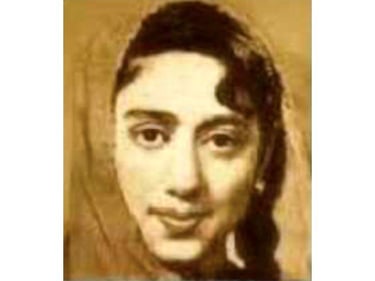
Obituary: Zubeda died not on Saturday but decades ago
At: THE EXPRESS TRIBUNE
Many think that Zubeda Khanum died on Saturday, but considering the enormous talent she possessed, she died the day she was asked not to sing anymore. She was told to live like a ‘good woman’ and a ‘good wife’. She was gradually pressured into staying at home and caring for her children.
This came from a husband who was Syed by ‘ethnicity’ and explained to her in many ways that women of Syed families do not perform. Not to mention that he himself got his name and livelihood by being a photographer in Lollywood and his brother, of course also Syed, earned his name, his status and his income from being a director in the film industry. The same film industry was an institution of opportunity and creative expression for both brothers, while it was a stigma for Zubeda. Perhaps I forgot to mention that Zubeda was a star on her way to the top when she was chosen by this Syed family for marriage. It was a big thing to marry the most popular singer of the time, with a promise that she would not be stopped from singing. She and her mother also saw comfort and security in a family much established in the industry and thought it would give her singing career some protection. The lucrative world of cinema was harsh to single, young and beautiful women. Little did she know that this protection would come at a very high price. She would have to eventually kill the artiste in her. This was not a death of her talent within her, but a murder – on the part of her family, the film industry and the society at large. The famous singer Zubeda Khanum died decades ago and no one shed a tear.
Zubeida Khanum was as famous as Madam Noor Jehan at one point. Her top hits included Teri ulfat me sanam dil ne bohat dard sahey; ae chand un se ja ker mera salaam (film: Sarfarosh); Kia hua dil pe situm (film: Raat ke Raahi); Aaey musam rangeeley suhaney; ghungat uthaun ke ghungat nikalun (film: Saat Lakh); and rotey hen chum chum nain (film: Sola Aney). Her Punjabi hits also acclaimed popularity across the country like Desan da raja mera babal da piara (film: Kartar Singh); Reshum da lacha (film: Yakey Wali); Bundey chandi de soney di nath (film: Chun Mahi); Sayio ni mera dil dharkey (film: Shiekh Chilli); and meri chuni dian reshmi tandan (film: Shehri Babu). The rising star caught everyone’s attention in the 1950s and took over the business of playback singing. Noor Jehan at the time was only singing for her own roles in films.
I described my meeting with Zubeda in detail in the last chapter of my book, “Forgotten Faces” (published by Lok Virsa) where I was trying to convince her to appear in a PTV show I was hosting. This was about women artistes who were very famous at one point but then vanished away from the lime light. I was a big fan of hers but with all my persuasive skills I was not able to get her in my program. Her family strictly forbade her.
She was not only stopped from singing but her past was weighed upon her as a stigma, especially when it was time to marry off her daughters. She was even forbidden to sing her songs in private gatherings. I will never forget the helplessness and yearning to sing in her eyes I saw that day. She told me she could not stand other young singers re-singing her songs. She said she still had enough in her to sing them herself if she could. Her eyes got wet when she made this claim. She had a hard time opening her heart to me but spoke in half sentences with a lot of hesitation. She only satisfies herself by singing religious songs during muharram at private majalis. Even permission for this was considered a big favour.
Ironically, her Syed son also chose the showbiz as his forte. Upon pressure from some senior television personalities he was convinced to get his mother on television a couple of times for an interview in her later life.
How many Zubedas will be murdered for the hypocrisy of our society and the fake and lopsided concept of ‘honour’. I am sorry for the person who died a few days ago but my hero who was a star and one of the best singers in South Asia was murdered a long time ago and everyone remained silent.
(The writer is a women’s rights activist and an authority on folk music and culture. She blogs on fouziasaeed.wordpress.com and tweets @fouziasaeed)


July 30, 2013
Sexual harassment charges: Shameless elite and the daughters of this nation
At: THE EXPRESS TRIBUNE
ISLAMABAD:
Recently, two universities have let down women students by protecting predator professors from sexual harassment charges. Quaid-e-Azam University, where serious convictions on charges of sexual harassment set a positive tone for the implementation of the anti-sexual harassment law a year ago, has now waivered under the pressure from our shameless elites.
One would imagine that after charges of sexual harassment of students have been proven against professors, they would be embarrassed and resign or hide somewhere, but in our dear country they shamelessly fight back, while their friends who obviously do not think there is anything wrong with pulling a student into their office for sexual fulfilment or asking for sexual favours in exchange of better grades, diligently support and protect such culprits.
Two recent cases in Quaid-e-Azam University, where teachers repeatedly sexually harassed students, were investigated thoroughly by a committee set up by the university for this purpose. In the past, the committee has also given honest and brave results. After investigation, the committee recommended that Inamullah Laghari be terminated and Abdul Samad Mumtaz be charged with minor penalties. Charges were proven in both cases. All parties had no complaints on the process and made no verbal or written record of any concerns on procedural grounds. After the committee made its recommendations to the university syndicate, the culprits realised that they would be convicted and started lobbying for a diversion. ‘Technical grounds’ is usually the back door.
The syndicate of Quaid-e-Azam University needs to understand the legislation and realise that it is not their personal discretion or whim that applies in this case. It is the job of the committee, authorised under the law, to do the inquiry. The syndicate only ensures if procedure was followed and endorses the recommendations.
In this case, they did not even bring in the inquiry committee members to ask them questions about the procedure. They simply constituted a new committee. This is the most negative precedent they could have set. This has opened the process to anyone wanting a custom-designed committee when they do not like the decision. In the new committee specially put together for the accused, members like Dr Qaisar Mushtaq — who is a person known to have sided with sexual harasser professors earlier — have been included. As some members made noise to protect the culprits, others watched silently. For how long will our shameless elite remain silent and allow the humiliation of the daughters of our nation?
In the case of Punjab University, a brave decision to terminate the services of a habitual sexual harasser, Iftikhar Baloch, was applauded two years ago. The notorious professor who maintained a bedroom next to his office on campus for his flirtatious activities kept using political elites to come back. Even then-prime minister Yousaf Raza Gilani and former governor Latif Khosa put pressure on the university to take him back. Recently, interim governor Ahmad Mahmud used his window of opportunity to get his friend back in the university. A woman high court judge decided that it was up to the governor to take the final decision. Very conveniently, the governor did the necessary paperwork and signed the orders to reinstate him. The university resisted, but the pressure took more of a ‘desi’ turn.
We make a strong appeal to Punjab Government to intervene and keep such predators out of our universities. Also stop them from threatening brave officials of the university who have resisted pressure for the last two years and have stood their ground. Also, for Quaid-e-Azam University, the PM and the HEC should send a strong message that the syndicate cannot go against the law. Legislation and procedure has to be followed. If they argue the soundness of the procedure, they should call the full committee and get a presentation from them. If they see any gaps or have suggestions to strengthen the procedures, they should make those to the committee legally authorised to investigate.
The legislation will only be effective if the intention of our elite and senior university officials is to bring some dignity to these houses of learning. We need to clean up our universities and educate the shameless educated elite — those who harass, those who protect them and those who remain silent and do not put their foot down.
The author is an authority on anti-sexual harassment legislation in Pakistan and has been monitoring its implementation.
July 4, 2013
The words describing ‘rape’: Blaming the victim, shielding the rapist
At: THE EXPRESS TRIBUNE
WASHINGTON DC:
Pakistani society is still a bit confused about who ought to be punished for a crime of rape. Although everyone agrees that the culprit should be punished, in reality quite the contrary happens. Unknowingly, our society punishes the victim and not the rapist.
Like murder, theft and mugging, rape is a crime done by a criminal, but society is quick to stamp the victim as having lost her and her family’s honour. Why does the rapist not lose his honour for committing such a crime?
What do you call a rapist in Urdu?
While we do have names for other perpetrators of crimes like qaatil, chor or daku; we don’t have a definite word in Urdu for a rapist. We do not even have a proper word for the act of rape. We use words like izzat lut gai (lost her honour) and Daaghi ho gai (stained) or more lyrical phrases like kati patang (torn kite) and sheeshe me baal aa gaya (a stained glass). All these phrases refer to the woman who was raped, showing how we are conditioned to reinforce the patriarchal cruelty of blaming the victim whilst shielding the rapist from any responsibility for the crime. More recent terms like zina bil jabar (adultery by force) do not aptly describe the crime.
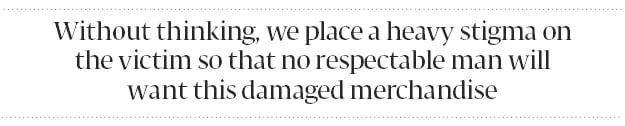
By using such language we become a party to this crime. Without thinking, we place a heavy stigma on the victim so that no respectable man will want this damaged merchandise. Our society has to understand that it is the social stigma that keeps the victim from speaking out and, thus, responsible for most rapists going scot-free. In most of the reported rape cases, the victim and her family have been harassed and intimidated to the extent that they have had to leave their neighbourhood or village. In many of these cases where a rape becomes public knowledge, children are told not to play with the children of that family, resulting in a social boycott of the victim.
She must’ve done something…
The belief that the woman must have provoked the crime is deeply ingrained in our culture. We immediately ask: Why did she wear fashionable clothes? Why was she out at that time? Why was she alone? Why did she not scream loud enough? We can quickly conjure up twenty reasons how SHE could have prevented the crime if she really wanted to.
We stereotype the woman who gets raped as young and provocative and the venue of the crime as dark alleys where no sensible women would venture alone, the reality is that victims range from the age of 2 to 70 years old and the venues of the crime range from universities, offices, markets and, most tragic of all, their own homes.
Rape on the silver screen
Just looking at our films and plays, it is clear that our script writers do not know how to handle this ‘dishonoured’ woman. They either have her jump out of a window or become an accidental victim of a stray bullet just to get her quickly out of the story because no other character can possibly interact with her normally. But if they have to take her character forward, perhaps because she is a star, they make sure it was only an attempted rape and the hero saved her in the nick of time. Thus, it is rare to see any female character continuing in a play or movie after she has been raped.
Life after rape
The news for the conscious mind of our society is that there IS life after rape. Almost 30% of women in Pakistan go through a rape or attempted rape at least once in their lives. They do survive. The pain stays, but they go on with their lives. Social boycott of a rapist might not be a bad idea for a change. Let there be a clear statement that it is time for us to say ‘enough’!

May 1, 2013
It’s time to hear the voice of south Balochistan
At: THE EXPRESS TRIBUNE
We have long complained about the feudals and tribal chiefs from Balochistan getting into politics and keeping this an area of dynastic rule. Each province has gone through its own dynamics but the people of Balochistan have suffered the most from the double jeopardy of undemocratic influences from Islamabad and from their own tribal elite. Provincial devolution and autonomy have opened the path for new possibilities for change.
Balochistan has always been an intriguing place. While Pashtuns in the north have a horizontal tribal power structure, the Baloch in the centre are very hierarchical, with their identities and rank tied strictly to their tribes. The southern Baloch tribal structures are not rigid and for decades, there has been a strong influence of modernism from across the Gulf. The central Baloch people remain stuck in their tribal traditions, ready to react aggressively to any deviation and always tense with Pashtuns. In contrast, the people of the south and west have been neglected by those in the central area.
Sometimes, being neglected can be a gift. The poor people of southern and western Balochistan have long gone abroad for jobs and sent back remittances for their families. This also resulted in exposure to international ideas which opened up the area to a greater diversity of values. They started educating their girls, involved their youth in productive activities and brought about change in their social hierarchies that could show the province how autonomy and not separation could be a midway to resolve Balochistan’s problems.
The ideas of the school of visionaries that developed in Balochistan from the times of Ghaus Bakhsh Bazinjo have never died. While the focus of the media has remained on separatists and big tribal leaders, the politics of ethics, vision and nationalism has survived and bloomed in the southern and western parts of Balochistan. Dr Abdul Malik Baloch, the head of the National Party, with his team of middle-class politicians, can be seen as a ray of hope that can significantly change the path of politics in the area and maybe, the nation. He set up thousands of schools when he was the minister for education and continues to groom women to join his party. Yet, he remains in the shadows of our election discussions.
In the past, such progressive and secular parties were ignored. Close to the elections, their core workers were tied down, blindfolded and thrown into remote areas for a few days to get them out of the way. This time, the Baloch militants are attacking them directly. Dr Malik narrowly escaped an attack just a few days ago and his workers also continue to be attacked. The election commission has to take notice of this and protect such parties there.
What we have been slow to realise is the change in the Pakistani nation that has gradually taken root over the past five years. Many who previously could not even dream of losing power are now at the mercy of popular opinion against them. Parties have chosen committed, middle-class people as candidates, adjusted seats with the Hazara Democratic Front, taken the risk of giving tickets to women candidates and avoided backing from major Baloch tribal powers. Observing these changes, one starts to gain faith in our democratic process.
In the coming days, we will see the election campaign unfold to its height. Provided that conditions are made somewhat safe, popular support will culminate in unexpected results. Let’s keep an eye on south Balochistan.


January 1, 2013
Human rights in 2012: As citizens take law into their own hands, rights lose out
At: THE EXPRESS TRIBUNE
The 2012 human rights situation in Pakistan can be assessed in three different ways. One approach is to tabulate the incidents of violations that have been reported.
A second view can be obtained from the international assessments of the rights situation in Pakistan. A third perspective can be drawn from evidence indicating whether our government has made progress in addressing the critical rights issues in our country.
The world focuses a lot of attention on the human rights violations in Pakistan. Everyone is aware of the shooting of Malala Yousafzai and the false blasphemy case against Rimsha Masih. In what other country are polio campaign workers murdered or children burned by acid thrown by their parents? Violence against women was enumerated in over 10,000 reported cases of rape, honour killing, domestic brutalities and acid attacks. Random bomb blasts and foreign drone attacks continued to result in numerous civilian casualties. Most violations against minorities go unreported or unresolved. Forced conversions, damage to places of worship and disputed cases of blasphemy are the source of daily fear.
The number of these crimes and their heinous nature resulted in Pakistan ranking among the bottom ten out of 197 countries according to Maplecroft’s Human Rights Risk Analysis. This puts us in the company of dictatorships like Burma, and marginally functional countries like Afghanistan and South Sudan. Newsweek analysed multiple rights aspects to determine the 10 best and 10 worst countries in the world for women. Again, Pakistan ranked among the 10 worst. The 2012 Gender Gap Report of World Economic Forum (WEF) placed Pakistan as 134 out of 135 countries, with only Yemen below us. The WEF assessment looks at indicators of economic participation, health, education and political participation.
In many of the other countries at the bottom of these lists it is the government that is the main perpetrator of human rights violations. In Pakistan, the situation is much more complex with the main rights violators being citizens.Our law enforcing agencies are sometimes a party to these violations, but more often their role is in failing to either prevent or prosecute. The delays in the justice process and low conviction rates continue to give violators the impression that they have nothing to fear. While these global ratings do not give a complete picture of our situation, they are stark enough to jolt anyone who still believes we don’t have a problem.
The pace of human rights legislation slowed considerably in 2012. Early in the year, the parliament finally approved the revised law on the National Commission on the Status of Women. Then it passed a law for the National Human Rights Commission. Other critical legislation, however, stayed pending. The comprehensive bill on acid attacks remained tied up in the human rights ministry for eleven months before it was finally tabled as a private member bill in December. A Child’s Rights Commission seemingly had support of all political parties, yet never passed. Opposition from several religious parties again was enough to push the Domestic Violence bill off the agenda. The bills on Hindu and Christian marriage and divorce remain somewhere in the human rights ministry. Nevertheless, in December, the president did sign a law advancing the cause of free education and another bill on due process of law for every citizen was passed by the National Assembly and awaits only Senate approval.
The fractured power dynamics in our national politics means that the will to counter human rights violations remains weak. Human rights legislation continues to be a minefield where those with the power to change also fear political and physical retaliation. We can see a change in this scenario in 2013 and onwards only if the parliament, government, judiciary, media and citizens unite to root out this problem.
The author is a human rights activist, currently doing research at the National Endowment for Democracy in Washington DC.
December 23, 2012
A salute to the working women of Pakistan
At: THE EXPRESS TRIBUNE
The celebration of National Working Women’s Day, which was yesterday, on December 22, acknowledges women who engage in work of all types in our country. They have entered the workforce in spite of adverse circumstances. Thus, while we express our pride in the women who succeeded in opening doors for other women, we must also reflect on the difficulties they continue to face.
When we think of the 1950s, 60s and 70s, we have vivid images of women in professions ranging from agricultural fields to teaching and even in senior policymaking. There is no doubt that the range of jobs has expanded to include judges, parliamentarians, restaurant workers, media professionals, fighter pilots and police commandos. But as the number of working women has increased, so too have the constraints they face on a daily basis.
The future political debate and agenda-setting of our political parties has to include concrete steps to develop a more supportive environment for working women. Poverty reduction has been a flagship agenda for international donors as well as our own government for many years. The focus has often been on handouts and high-cost input programmes through social welfare projects. It is high time that poverty reduction strategies move on from small handicraft initiatives to addressing the constraints that prevent women from entering mainstream employment in ever greater numbers.
A truly enabling environment must first and foremost address the issue of transportation. Women have proven their conviction to advance themselves despite inadequate public or private transportation. Driving two-wheelers has long been restricted to males. Our city bus systems have never fully met their needs, while taxis and rickshaws are too expensive an option in light of their meager salaries. Solid programmes for providing good public transportation options would play well with women voters.
Often because of poor transportation, most Pakistani working women remain in the informal sector with a large percentage working at home. There is a need to provide a safety net for these vulnerable women. The current social security laws inadequately cover women workers. New legislation and implementation of current policies for home-based workers and women in the informal sector need to be high on the agenda of our next government.
The struggle for equal pay for the same work needs to be highlighted. In many areas of central and south Punjab, the daily wage of a woman farm worker, e.g., a cotton picker, is exactly half that of a man who picks the same amount of cotton. In addition, private as well as government employers have been quite miser in giving women their rightful benefits under the law for maternity leave, sick leave and promotions.
Among the positive steps already taken, the laws against sexual harassment stand out. This legislative package not only addressed the issues in the organised workplaces, but also stamped the legitimacy of women to enter all work and public spaces. Despite years of militancy and chauvinism aimed at pushing women behind the four walls of their homes, they have continued to assert their right to be economically active citizens. Although still in process, the implementation of these laws has shown concrete results. Sexual harassment cases filed by women under these laws now number in the thousands. Still, the provincial governments need to address this issue more seriously.
The list of pressing issues faced by working women will never be reduced until our political parties recognise that women’s issues are not just petty complaints. The constraints faced by one-half of the electorate affect the progress of the entire nation. Simply because they have been ignored over the decades does not mean that they are not vital to our nation’s economic health. After seeing the broad appreciation shown for some gains made during these past five years, no party can afford to ignore women’s issues any longer. The debates during the coming electoral campaign will need to be real and the proposals will need to be concrete.
December 8, 2012
Committing diplomatic suicide?
At: THE EXPRESS TRIBUNE
I have listened to many talks on Pakistan in Washington DC recently, with nearly all giving a generally negative impression of our country. Pakistan on the Brink, Pakistan: A Nation at War With Itself, Playing with Fire: Pakistan At War With Itself. These are some books, written this year, about the violence that has engulfed Pakistan’s cities, the economic hardships and the deterioration of our institutions.
William Milan, a scholar who lived in Pakistan before the Afghan war days, said that analysts primarily understand Pakistan through Afghanistan and in the context of ‘security’ issues, they don’t know its history. Still, I was shocked to meet a young member of the Foreign Relations Committee of the US Congress who remarked that nothing substantive had happened over the last four years in Pakistan. I immediately responded, “all of our political parties came to a consensus agreement on amending over 100 clauses of our Constitution, with major positive implications on our democratic structure. Wouldn’t you consider that substantive”? No, he didn’t.
However, it is not just Americans who see Pakistan in a bad light. It has become all too easy for Pakistanis to blame one another or, most conveniently, blame the “corrupt politicians” for all our sins. But in so doing, we all contribute directly to the negative image of our country, creating the impression that no one in their right mind should have anything to do with us. Having stamped ourselves as a terrorist nation and a security threat to the world, we are moving towards diplomatic suicide.
Unfortunately, complaining and self-pity has become a part of our national psyche, sprinkled with a defeatist attitude that nothing can work in this country and topped with a tendency to pull anyone down who tries to make an effort. These characteristics clearly distinguish us from other nationalities who work very hard to promote the interests of their countries, especially when outside their country.
“The Israeli lobby in the US is considered to be the most effective in ensuring the interests of their country”, said a lawyer during a seminar. Another policy expert said, “the problem with the Pakistani diaspora is that most do not lobby for their country; they are too fragmented by their party rivalries back home.” Some politicians on their visits to America only run down the current system in order to raise funds for themselves. At times, senior officials from the establishment overplay the negatives to make the bureaucracy seem more important. The civil society also has a tendency to overplay negative issues as that attracts attention and funding. The cannibal tribes of the Pacific and the terrorists of Pakistan make equally sensational headlines. As a result, we have created such a market for negative news that anything positive doesn’t sell anymore. We do not have to be in denial about our problems but we need to learn how to share them in a way that builds solidarity with our struggles rather than contempt for our limitations.
Irfan Malik, a Pakistani-American heading a US-Pakistan foundation, released a study on the Pakistani diaspora at the Wilson Centre. He shared that Pakistani-Americans are more engaged in raising funds to support social causes in Pakistan. He added, “politically, they contribute to the US political campaigns and have good links with many key politicians but they have still not been able to influence the political agenda to benefit Pakistan”. We, as a nation, have to understand that our image in the world needs to be improved. India has deep poverty, religious fundamentalism and extensive social problems. Yet, it is consistently seen in a positive light because Indians consistently promote their national interests over local political affiliations.
We can tell many stories of communities creating innovative solutions. We have examples of legislation that no one else in South Asia has. Our political parties jointly made our Election Commission stronger. We have a government that has just completed its five-year term and we are moving towards a smooth transfer of power. A good starting point can be to begin respecting ourselves, our country and positive initiatives that people take. The solidarity displayed by the international community on Malala Yousufzai’s stance is an example of how we can tell the story of the hundreds of people who resist militancy in Pakistan every day. We have to tell our positive stories and avoid running ourselves down. With all the challenges we face at home, we don’t need the entire world against us.
October 8, 2012
Parliament drags feet over acid crimes bill
At: THE EXPRESS TRIBUNE
The delay in getting a comprehensive bill against acid and burn crimes on the agenda of Parliament is of great concern to citizen groups who have been working hard for the last several years to present options to politicians.
Recent efforts by MNAs, including Dr Attiya Inayatulla (Pakistan Muslim League-Quaid) who has mobilised the support of other women legislators from all parties, gives us high hope for its passage. Perhaps once the bill is taken out of the clutches of the bureaucracy, it might see unanimous support in the National Assembly.
One proposal from the Acid Survivors Foundation, which was modified by the National Commission on the Status of Women last year, was presented to the ministry of human rights. After a wait of around eight months, citizen groups decided to give up on it becoming a government bill and pinned their hopes on committed politicians to take it on as a private member bill. Dr Inayatulla took up the challenge to get the bill passed for application in the Capital Territory and got several MNAs to endorse it. In the process, the legislators got support from their parties and built a broad-based consensus. The saga of acid victims in Pakistan has made an impact on the hearts of every Pakistani and is now known to the world through Sharmeen Obaid-Chinoy’s Oscar winning film, “Saving Face”. This is one social bill that religious parties are also expected to fully support in order to hold the culprits accountable.
The Islamabad Capital Territory (ICT) Acid bill became a victim of the inaction of the human rights ministry throughout 2011 and the first half of 2012, and thus could not be presented as a government bill. Unfortunately, it has now become lost in the complicated labyrinth of our parliamentary process. After it was submitted to the National Assembly as a private member bill, it was again sent to the relevant ministries for comments – which never came. This bill was expected to be presented right after the budget session, but the wait goes on.
The film that won the Oscar for Pakistan in February 2012 highlighted the issue and showed the Pakistan Penal Code (PPC) amendment, which had been passed by our Parliament in December of 2011, had been both correct and timely. However, that amendment is not enough to stop this heinous crime. Many instances of this crime go unreported out of shame or fear. Even so, on average, 150 acid attacks get reported every year, but the conviction rate is only six percent.
Citizens of Pakistan request Parliament to take up this bill for the ICT as an example of political resolve to encourage the provinces to pass their own laws. However, for now, before the Parliamentarians get a chance to show their support for the ICT Acid bill, may we ask the bureaucrats, especially those in the interior ministry, to unclench the bill so it may come back to the National Assembly for a vote?
Our parliament started the process of addressing acid crimes by passing the PPC amendment in 2011, but it needs to pass the comprehensive bill in 2012. The amendment has to be coupled with more comprehensive legislation which takes care of the details around investigation of the issue, medical treatment of the victim, rehabilitation and other significant issues. Like the sexual harassment laws that came in a pair, one amendment and one comprehensive law, the acid crimes also have to come in a pair. We hope that before the interim government sets in, the legislative agenda for this major crime can be passed. We need support from as many stakeholders as possible so we can become serious about rooting out such blatant attacks on humanity.
July 7, 2012
Who leaked the news about the Kohistani women?
The recent case of the alleged murder of five women in Kohistan was hot news all around our nation. Our government and civil society joined hands and responded professionally soon after the news broke. The case was partially resolved upon finding out that some of the women were safe … for the moment. Although the story has subsided at the national level, beneath the calm surface it has become more alive than ever before within the local community.
Who leaked the news to the outside world is now the key question. It reminds me of what happened after the death of Osama bin Laden. In the past year, we have learned little from the special investigation about who created the safe haven for Osama but, one after the other, those who gave information about him to the US have been hunted down and punished.
In Kohistan, the local administration officials have made no comment on how this case has unveiled the barbaric customs that continue to persist in the Kohistan society. Rather, they seem obsessed with figuring out how to prevent such stories from getting out in the future. Once the bright light of the national media shifted elsewhere, the local administration started bad mouthing Afzal, the young man who broke the news to the media, by narrating stories of his alleged notorious past. In addition, the brave young men in Pattan, Dassu and other towns with links to various media outlets have been threatened by the Kohistan DCO and DPO. A local stringer told me, “we were told that if any negative story about killing or humiliating women in Kohistan leaks out, they will issue FIRs against us and our whole families”. When will these ‘officials’ learn that it is the occurrence of inhuman acts, such as the regular killing of women for honour as well as the February murder of Shia pilgrims on their way to Gilgit that brings shame to the people of Kohistan and to our nation, rather than the telling of the story?
At the same time, the local religious leaders are moving against all change agents in their midst. Some of the more enlightened locals with outside exposure represent one of the only possibilities to help the peasants break the chains that bind them to these barbaric traditions. But NGOs are always an easy target. Several fatwas have already been issued but they don’t seem to have been effective. So, the latest move has been to pass a fatwa to separate the NGO workers from the community. This recent fatwa bans anyone from saying funeral prayers over the body of a person who has ever received assistance from an NGO.
How can such a palpable political power play be allowed under the cover of religion? The provincial government has already issued a statement condemning the fatwa. Our president, with his authority over tribal affairs in the country, should take notice of such notorious fatwas and authorise the governors to take action against individuals who are inciting illegal acts.
It is often not the decisions of traditional jirgas that are fanning the flames; it is radical religious groups that are often leading the process. But the cover of tribal customs has long been used by power brokers at many levels of our society to serve various purposes. These practices should not be accepted any longer. We have to stop walking on egg shells when addressing tribal tradition if its actions counter Pakistan’s laws. Based on my discussions over the past month and my earlier work in tribal areas, I believe the people of Kohistan and some of their tribal leaders truly want to find a way to create a better world for their children. Unfortunately, the local administration has become a major hurdle because their inaction empowers the mullahs to keep these people in the Stone Age.
The province of Khyber-Pakhtunkhwa has restored the old colonial Commissionerate system. The Hazara commissioner was involved in missions to locate those five women; let’s see if he can enforce the laws of Pakistan in that area and convict those who unrepentantly take the lives of women and anyone else they decide is not deserving of life. If he can’t, what real purpose does a commissioner serve?